
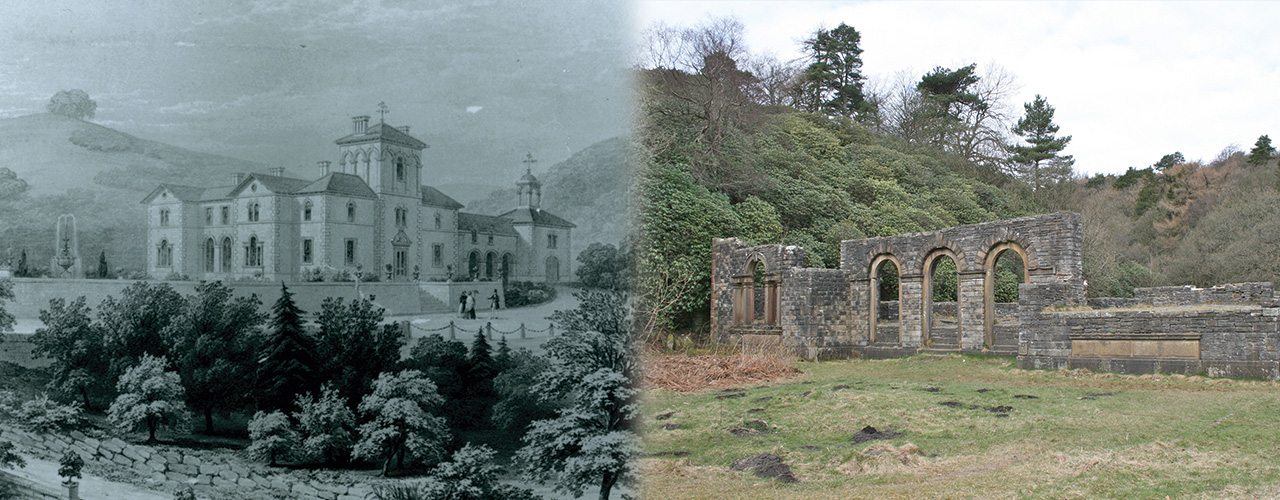
Above: The illustration on the left is by the young Italian architect of the Hall, Alexander Roos, and would have been drawn sometime around 1840. In less than 100 years this grand country house would have been reduced to the sad state shown on the right.
Goyt Valley timeline
This timeline shows the major cultural events in the valley’s history, including the arrival of the Grimshawe family who built Errwood Hall, to the construction of the two reservoirs which completely changed the landscape.

I’ve added I, II, III and IV after the various Samuel Grimshawes to help identify them. Samuel Grimshawe I. Samuel Grimshawe II (1768-1851). Samuel Grimshawe III (1811-1883). Samuel Grimshawe IV (1850-1851).
c.1670: Thomas Pickford works the quarry at Goytsclough – the origins of the Pickfords removals firm. By about 1695 he has bought the quarry and is mending roads.
c.1800: Land for the Gunpowder Mill is acquired from Francis Jodrell.
1831: Opening of the Bunsall incline on the High Peak Railway line which runs through the valley, joining the canals at Cromford and Whaley Bridge. Today, this forms the main way into the Goyt Valley from the Buxton to Whaley Bridge road.
1832 (9th April): Samuel Grimshawe (II) purchases the 2010 acre Errwood Estate from John William Jodrell for £9250. The contract states; “…the fee simple and inheritance free of Incumbrancces of and in the Goit’s head and Erwood Estates in Taxal called Erwood, Goits Bridge, Within Leach, Goits Clough, Castedge, the Cat & Fiddle public house, Gamekeeper’s House, dog kennels, etc.”
c.1845: Work starts on constructing Errwood Hall, designed by Alexander Roos and overseen by Samuel’s son, Samuel Grimshawe (III).
1849 (18th June): Samuel Grimshawe (III) marries Jessie Allan in Edinburgh.
1850: Samuel Arthur Grimshawe (IV) born at Errwood Hall.
1850 (June): Samuel’s mother, Anne Grimshawe, dies and is buried at Taxal Church, where a memorial remembers her and her husband.
1851: Samuel Grimshawe (II) dies aged 83, leaving the estate to his son. Samuel Grimshawe (III) converts to Catholicism.
1851: Samuel Arthur Grimshawe (IV) dies at Errwood Hall aged just one.
1851 (8th October): The private Catholic chapel at Errwood Hall is consecrated by the Bishop of Shrewsbury before about 500 people.
1851 (7th December): Birth of Samuel Grimshawe’s eldest daughter at Errwood Hall; Mary Ambrose Jemina Louisa.
1852: Birth of second daughter in Paris; Anne Genevieve Marie (known as Genevieve).
1860: Samuel Grimshawe donates £500 towards the cost of a new church in Stockport. And £100 towards the cost of St Anne’s Church in Buxton. Later that year, 7-year-old Genevieve Grimshawe lays the foundation stone at St Anne’s Church.
1870: Samuel Grimshawe purchases the Marquita, an ocean-going yacht.
1873 (6th September): ‘Coming of Age’ ceremony held at Errwood Hall for the Grimshawe sisters; Mary and Genevieve.
1883 (20th April): Samuel Grimshawe (III) dies at Errwood Hall, leaving Errwood Estate to his wife, Jessie.
1889: The date carved on St Joseph’s Shrine, along with the initials D de Y of Dolores de Ybarguen, Jessie Grimshawe’s Spanish companion.
1890: Goytsclough Paint Factory closed.
1891 (21st January): Genevieve (32) marries Captain Edward Francis John Preston (45).
1892: The section of the High Peak Railway between Ladmonlow (near Buxton) and Shallcross (Whaley Bridge) closed. This included all the line running through the Goyt Valley.
1893 (6th December): Jessie Grimshawe dies in London, leaving the Errwood Estate to her two daughters, Mary & Genevieve.
c.1896: Esme Preston, aged about six, comes to live at Errwood and is brought up there by Genevieve.
1900: Opening of The Sacred Heart Catholic Church in Whaley Bridge. Samuel Grimshawe (III) had purchased the land for £500.
1901 (1st March): Genevieve’s husband, Captain Preston (56), dies on holiday in France. His body is brought back to Errwood and buried at the family’s hilltop graveyard.
1902 (16th July): Mary Grimshawe (51) marries Hellier Robert Hadsley Gosselin (53).
1909: An explosion at the Gunpowder Mill kills three men – the worst accident recorded there.
1920: Gunpowder Mill ceased production
1924 (31st March): Mary’s husband, Hellier Gosselin dies and is buried at the family’s hilltop graveyard.
1929 (26th January): Genevieve dies in France and is buried at the family’s hilltop graveyard.
1929 (November): Mary asks for midnight mass to be held in the chapel once more at Christmas; around 40 people attend.
1930 (23rd February): Mary dies, the last direct descendant of the Grimshawe family, and is buried at the family’s hilltop graveyard.
1930: Stockport Corporation purchases the Errwood Estate for the construction of the two reservoirs; Fernilee and Errwood.
1930 (16-20th June): Auction of Errwood Hall contents.
1930: A severe flash flood spells the end of Castedge coal mine on the estate.
1931 (Easter): Errwood Farm opens as the Goyt Valley youth hostel – one of the first in the country.
1932: Work starts on the construction of Fernilee Reservoir, with the inauguration ceremony held on 29th September and filmed by Pathé News. (View cine film of inauguration ceremony).
1934: Errwood Hall and 13 farms and cottages on the estate are demolished, including Goyt’s Bridge. (View cine film of Goyt’s Bridge taken just before demolition).
1935 (30th September): The Goyt Valley youth hostel at Errwood Farm closes, and the farm is demolished for the construction of the reservoir.
1937: Fernilee Reservoir is completed.
1964: Work starts on Errwood reservoir.
1968 (14th June): Errwood Reservoir officially opened by the Duchess of Kent.
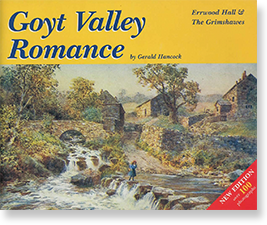
Much of this information is taken from Gerald Hancock’s wonderful little book, ‘Goyt Valley Romance’. It’s sadly been out of print for some years but Christine Hancock has kindly allowed me to reproduce it in full, on this website.